
Manage daily problems with PDCA.
List daily operational problems, measure action performance; run owner and due-date tracking from a single panel.

Manage actions in the digital environment
PDCA (Plan–Do–Check–Act) is the core problem-solving technique of lean production.
Instead of discussing a problem once and forgetting it, PDCA lets you plan, implement, check and make the solution permanent. The digital panel keeps the owner and due date of every action visible.
Request a preliminary meeting →Make problems visible
The panel makes daily problems visible and enables actions to be planned.
Owner and due-date tracking
Every action is tracked with its owner and due date.
Automatic reporting
Delays, risks and bottlenecks are reported automatically by the system.
Priority problems
The system notices deviations in daily operations and helps find the source of the problem.
Instant tracking in meetings
In the morning production meeting, the entire PDCA flow is followed from a single screen.
Institutional memory
Every solved problem and action taken is recorded; a long-term body of knowledge builds up.
Link Daily Tasks and Delegations to Performance in Gemba OpXSuite
Six steps work in a single flow: data is collected, factory performance is seen, indicators are monitored, daily performance is managed, deviation is prioritized, and the impact of the action is verified again in the indicators.
Data collection
Data flow is established from SQL, Oracle, ERP, SCADA, MES and Excel sources.
Overall factory performance
Daily summary of the factory; indicators outside target stand out.
SQCDM
Indicators are monitored in the structure of safety, quality, cost, delivery and motivation.
Daily KPI / performance
Targets are defined, daily data is managed from a single center.
Pareto – deviation management
Deviations are ranked by impact and priorities are set.
PDCA
An owner and due date are assigned; the impact is verified in the indicators.
PDCA actions together with performance indicators
In daily Asakai meetings, PDCA actions are tracked together with performance indicators.
- A single-screen flow that speeds up the problem-solving cycle.
- A shared view that strengthens communication between teams.
- Institutional memory built by recording solved problems.
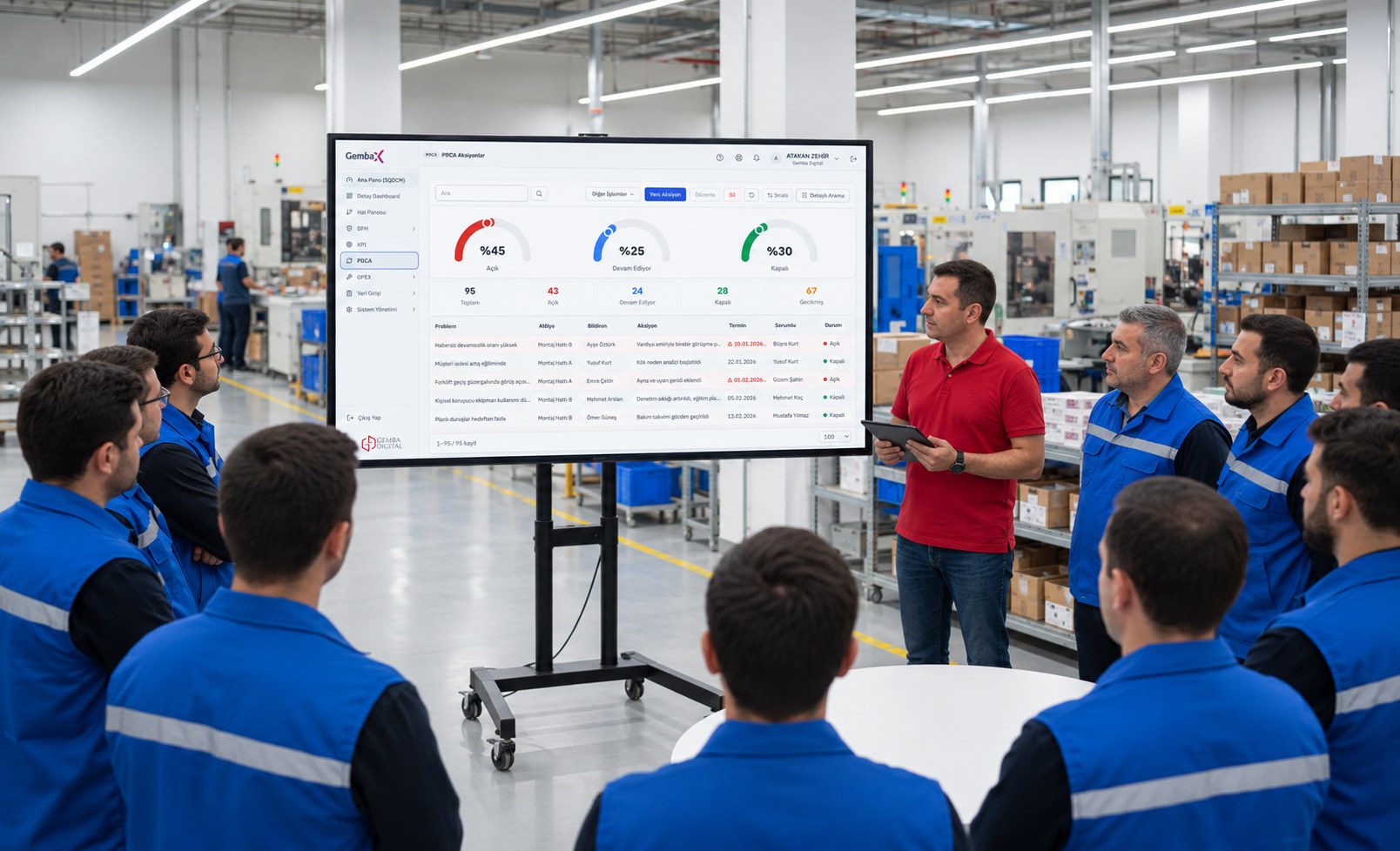
How is it used on the shopfloor?
The problem is defined, the action is planned, an owner and due date are assigned.
The action is carried out on the shopfloor; status is updated from the panel.
The impact of the action is monitored in the performance indicators.
The solution is standardized; the record enters institutional memory.
The same screen for every management level, with different detail
- Problem owner. Sees their actions, due dates and statuses in a single list.
- Shift supervisor. Reviews open and overdue actions with the team in the daily meeting.
- Department manager. Tracks delays and risks with automatic reports.
- Process improvement. Records solved problems and prevents their recurrence.
Works with your existing systems
Data is taken from the corporate database and source systems; it ties into the daily flow without creating a separate data-entry burden.
Frequently asked questions
What is PDCA?
It is the cycle of detecting problems, producing solutions, verifying implementation and continuous improvement; it is the core problem-solving technique used in lean production.
What is PDCA task management?
It is a holistic management process covering problem definition, action planning, owner assignment and due-date tracking.
How does Gemba OpXSuite manage the PDCA process?
It makes problems visible, assigns actions to owners, reports delays and records solutions.
What does the PDCA dashboard bring?
Fast capture of deviations, team coordination, root-cause resolution, reduced cost and quality losses, and a sustainable OPEX culture.
How are overdue actions tracked?
Delays, risks and bottlenecks are reported automatically by the system; the owner and due date are visible on every action.
How are PDCA actions linked with indicators?
In daily meetings, PDCA actions are tracked together with performance indicators; the action's impact is seen in the indicator.

Let's Turn Problems into Opportunities
Talk to our expert team about setting up the PDCA structure and shopfloor consulting.